Bokeh Patterns: Seamless Vector Backdrops
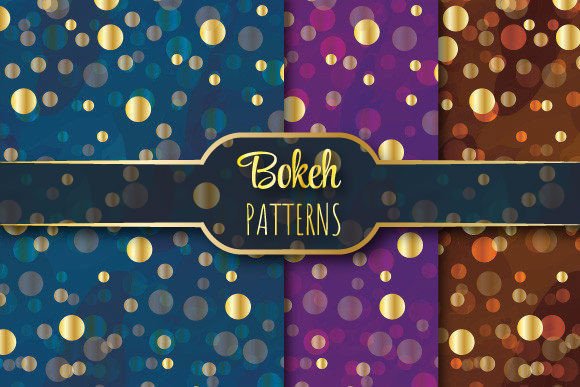
Bokeh Patterns are elegant, softly blurred circular motifs arranged in seamless, tileable layouts—designed not as static photos, but as scalable vector graphics. Unlike raster bokeh images that pixelate when enlarged, these patterns are built in EPS 10 format, meaning every curve, gradient, and transparency is mathematically defined and infinitely resizable without quality loss. Each pattern measures 12 × 12 inches (3600 × 3600 pixels at 300 dpi), optimized for both digital display and professional print—whether you’re designing a wedding invitation, branding a Shopify store, or illustrating a textbook chapter.
Why Seamless Matters—Across Roles and Real Projects
“Seamless” isn’t just a design buzzword—it’s functional necessity. A repeating vector pattern aligns perfectly edge-to-edge, so when tiled across a website background, fabric swatch, or packaging wrap, there’s no visible seam, no awkward gap, no duplicated highlight. That reliability shifts how different people approach their work:
- Freelancers and small business owners value speed and consistency: one Bokeh Pattern file can generate dozens of branded assets—email headers, social media banners, presentation decks—without re-exporting or adjusting alignment each time.
- Educators and course creators use them to add visual calm to slides and handouts. A soft bokeh backdrop reduces cognitive load compared to busy textures—especially helpful for neurodiverse learners or students viewing content on smaller screens.
- Bloggers and content marketers rely on fast-loading, high-fidelity visuals. The included JPEG versions (optimized at full resolution) let them drop polished backgrounds into WordPress or Canva instantly—while the EPS gives them room to grow if they later hire a designer or upgrade tools.
- Hobbyists and DIY crafters appreciate flexibility: print a single pattern on sticker paper for custom laptop decals, or repeat it across a large-format vinyl sheet for wall art—all from the same source file.
Beginners vs. Experienced Users: What Changes—and What Stays the Same
If you’ve never opened Adobe Illustrator—or even if you use it daily—the structure of this package meets you where you are.
Beginners often prioritize immediate usability. That’s why each download includes three JPEG files alongside the EPS: one with a subtle center emphasis (ideal for hero sections), one with balanced density (great for overlays), and one with higher contrast (works well on dark mode interfaces). No vector software needed—you can drag any JPEG straight into Google Slides, Mailchimp, or Instagram Stories.
Experienced users, meanwhile, look deeper: the EPS 10 format supports live gradients, editable layers, and CMYK color definitions—meaning designers preparing packaging for offset printing can adjust spot colors or fine-tune transparency stacks without rasterizing. And because the pattern repeats mathematically—not by copying and pasting bitmap tiles—it scales cleanly to billboard size or laser-etched acrylic without artifacts.
Quality That Scales—Without Compromise
At 300 dpi and 3600 × 3600 pixels, these files bridge two worlds: precision print requirements and modern screen densities. That resolution ensures crisp output whether you’re printing letterhead on an office laser printer or producing a gallery-wrapped canvas. But more importantly, the vector foundation means the *design intent* stays intact. A photographer might love bokeh for its organic imperfection—but a designer needs control over shape distribution, blur intensity, and spacing rhythm. These patterns deliver that control while preserving the gentle, luminous feel associated with real lens bokeh.
Consider a freelance UX writer crafting a client’s onboarding flow: they might apply a low-opacity bokeh overlay behind key interface text to soften focus and guide attention—knowing the pattern won’t blur further or degrade when viewed on a 5K monitor. Or a boutique owner creating seasonal labels: they can embed the vector directly into their label-printing software, confident it will hold detail at 1.5-inch width.
Commercial Use? Yes—With Clarity
All files are licensed for commercial use, including resale in physical products (e.g., printed notebooks, textile designs) and digital templates (e.g., Notion themes, Canva layouts). There’s no subscription, no attribution requirement, and no hidden limits on impressions or units sold. That simplicity matters most to entrepreneurs launching side hustles or educators selling printable classroom resources—they need certainty, not legal guesswork.
Still, it’s worth noting what this package doesn’t do: it doesn’t include animated versions, SVG variants for web developers, or AI-generated variations. It’s a focused, high-integrity set—not an endless library. That restraint serves users who prefer curation over clutter: fewer options, zero bloat, faster decision-making.
Finding Your Fit—A Practical Check-In
Ask yourself:
- Do you need backgrounds that work across multiple formats? If you regularly move between print brochures, email campaigns, and social posts, having one source (EPS) plus ready-to-use derivatives (JPEGs) eliminates conversion friction.
- Is scalability non-negotiable? If your projects range from Instagram avatars to trade show backdrops, vector-based bokeh avoids the “I’ll fix the resolution later” trap.
- Do you value creative breathing room—not just decoration? These patterns aren’t filler. Their gentle repetition creates visual rhythm, supports typography, and adds emotional tone (calm, luxury, warmth) without competing for attention.
- Are you balancing learning with output? Beginners gain confidence using JPEGs now; professionals deepen skills by exploring the EPS structure—layer names, clipping masks, gradient meshes—all preserved and organized.
No tool fits every need. If your work demands rapid iteration across hundreds of color variants, you might pair these with a parametric design plugin. If you’re building interactive web experiences, you’d likely convert the EPS to SVG later. But for clear, quiet, professional-grade texture—where elegance meets utility—Bokeh Patterns offers grounded, thoughtful execution.
A Note on Long-Term Usefulness
Good design assets age well—not because they’re trendy, but because they’re neutral enough to adapt. These bokeh patterns avoid dated filters or overly stylized effects. Instead, they lean into proportion, balance, and optical harmony: qualities that remain effective whether you’re designing in 2024 or archiving assets for future reference. Educators reuse them across academic years. Small studios embed them into brand guidelines. Even hobbyists find themselves returning—not as disposable downloads, but as trusted elements in a personal visual toolkit.