Georgian Traditional Ornaments: Timeless Caucasian Motifs Reimagined for Modern Design
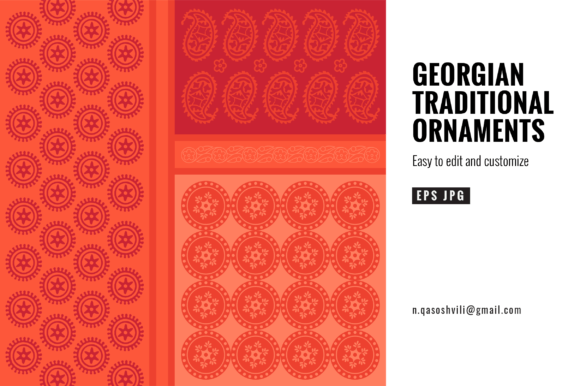
For centuries, Georgian traditional ornaments have served as silent storytellers—encoding history, faith, nature, and identity into intricate lines, spirals, and symmetrical forms. Rooted in the rugged landscapes and ancient cultures of the South Caucasus, these patterns are far more than decorative flourishes. They are visual heirlooms—passed down through generations of weavers, woodcarvers, metalworkers, and muralists—each motif carrying symbolic weight and regional nuance. Today, this rich heritage is experiencing a vibrant resurgence—not just in museums or folk festivals, but in contemporary fashion, home interiors, digital art, and global merchandise. We’re thrilled to introduce a new collection of native seamless vector ornaments inspired by authentic Georgian motifs—designed for versatility, scalability, and creative authenticity.
The Soul Behind the Symmetry: What Makes Georgian Ornaments Unique?
Unlike many ornamental traditions that prioritize floral or geometric abstraction alone, Georgian traditional ornaments fuse both with deep cultural resonance. Common elements include:
- Eight-pointed stars—symbolizing cosmic order and divine protection, often seen in church frescoes and ceremonial textiles;
- Interlacing grapevines and pomegranates—emblems of fertility, abundance, and Georgia’s millennia-old viticulture;
- Stylized birds (especially doves and eagles)—representing peace, spiritual ascent, or ancestral guardianship;
- Meander borders and endless knots—reflecting continuity, eternity, and the interconnectedness of life;
- Zoomorphic and anthropomorphic silhouettes—subtly embedded in larger compositions, echoing pre-Christian animist beliefs later harmonized with Orthodox Christian iconography.
What sets Georgian ornamentation apart is its regional diversity. A Svanetian cross-stitch pattern from the mountainous northwest features bold, angular motifs and stark black-and-red palettes—designed for visibility against snow and stone. In contrast, Kakhetian embroidery from eastern Georgia favors flowing vine scrolls and delicate floral infill, mirroring the lush river valleys and sun-drenched vineyards. Even within a single region, motifs vary by function: a wedding shawl carries different symbols than a funeral cloth or a liturgical banner.
From Ancient Looms to Digital Canvases: Why These Patterns Matter Today
In our fast-paced, globally connected world, there’s growing appreciation for design that feels intentional, meaningful, and human-scaled. Georgian traditional ornaments offer exactly that—a bridge between craftsmanship and consciousness. Their inherent symmetry and rhythm lend themselves beautifully to seamless repetition, making them ideal for modern applications like:
- Fabric printing for sustainable fashion brands seeking culturally grounded prints;
- Home textile collections—from table linens and cushion covers to wallpaper and upholstery;
- Digital backdrops for social media, virtual events, and branding with regional authenticity;
- Invitations and greeting cards that elevate celebrations with subtle cultural depth;
- Merchandise for museums, cultural festivals, or travel brands promoting Georgian heritage;
- Interior wall art and poster designs that balance bohemian warmth with refined structure.
Importantly, these aren’t “ethnic” clichés or superficial pastiches. Our new vector collection honors the original proportions, spacing, and compositional logic found in historic artifacts—from 10th-century church carvings to 19th-century silk ikats—while optimizing them for today’s design workflows.
No More Pixelation, No More Guesswork: The Power of Native Vector Files
One common misconception is that “traditional” equals “static” or “low-res.” Not anymore. This collection delivers 100% native vector illustrations—mathematically precise, infinitely scalable, and fully editable in Adobe Illustrator, Affinity Designer, or CorelDRAW. Each pattern is built with clean anchor points, consistent stroke weights, and intelligent grouping—so you can recolor, resize, rotate, or isolate elements without distortion.
The ZIP package includes:
- 1 EPS file—industry-standard, backward-compatible, and print-ready at any size;
- JPG previews—high-resolution (300 DPI) for quick reference, mockups, or web use;
Because they’re seamless, these patterns tile perfectly—no visible seams, no awkward repeats. Whether you’re designing a 2-meter-wide tapestry or a 5-cm fabric label, the integrity of the motif remains intact. And unlike raster-based “boho” packs flooding online marketplaces, these are authentically sourced—researched from archival photographs, museum collections, and field documentation across Georgia’s UNESCO-recognized cultural zones.
Beyond Aesthetics: Cultural Respect and Creative Responsibility
Using traditional motifs carries ethical weight. That’s why this collection avoids sacred or ritually restricted symbols—such as certain ecclesiastical crosses used exclusively in liturgical contexts—or motifs tied to specific clan lineages without permission. Instead, it focuses on public-domain decorative vocabulary: widely shared border patterns, universal nature motifs, and stylistic conventions documented across multiple regions and time periods.
This approach supports cultural sustainability: when designers credit origins, collaborate with Georgian artisans, or license ethically sourced assets, they help preserve intangible heritage—not as frozen relics, but as living, evolving practices. Several patterns in this set were co-developed with textile historians from Tbilisi State Academy of Arts, ensuring contextual accuracy without compromising creative flexibility.
How to Use These Ornaments Effectively (Even If You’re New to Pattern Design)
You don’t need to be a textile expert to harness their power. Here’s how to start:
- For fashion designers: Scale down vine motifs for delicate blouse prints; enlarge star-and-knot borders for statement coat hems.
- For interior stylists: Layer a subtle pomegranate repeat as wallpaper behind neutral furniture; use a bold meander as a runner rug border.
- For stationery creators: Crop a corner detail for envelope liners; invert colors for elegant foil-stamped invitations.
- For digital artists: Overlay low-opacity patterns as texture layers in Procreate or Photoshop; animate subtle shifts for motion graphics.
- For educators and students: Use the vector files to teach symmetry, tessellation, or cross-cultural visual literacy in art or design curricula.
Pro tip: Pair Georgian motifs with minimalist typography and earthy, natural palettes (ochre, charcoal, forest green, clay red) to honor their organic roots—avoiding overly saturated or synthetic color schemes that dilute their authenticity.
Final Thought: Ornament as Continuity
Georgian traditional ornaments remind us that beauty need not be fleeting—and tradition need not be static. Every spiral echoes an ancient shepherd’s path across the Caucasus; every vine reflects centuries of tending land and legacy. By integrating these patterns thoughtfully into modern life—on clothing we wear, walls we gather beside, or cards we send—we participate in something quietly profound: the ongoing translation of memory into meaning.
Whether you're launching a boutique textile line, refreshing your brand’s visual language, or simply seeking inspiration rooted in resilience and reverence—these vector ornaments offer more than decoration. They offer connection. And now, they’re ready for your next creative chapter.