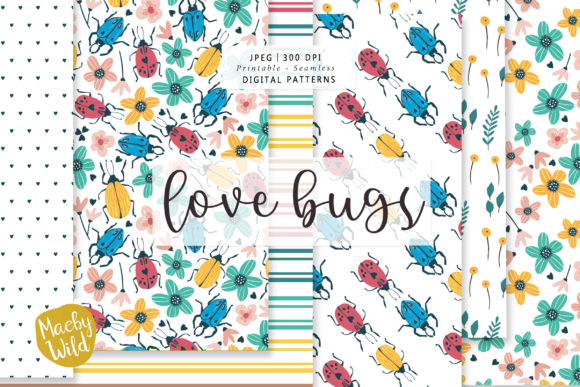
Love Bugs Insect Patterns
Imagine a garden buzzing with life—delicate wings catching sunlight, iridescent beetles resting on dewy leaves, ladybugs dotting clover like tiny punctuation marks. That gentle, joyful energy is captured in Love Bugs Insect Patterns: six hand-painted, digitally refined seamless digital papers designed to bring warmth, whimsy, and authenticity to creative projects.
Each pattern features real insect motifs—butterflies, dragonflies, bees, fireflies, ladybugs, and more—painted from observation in a small garden studio, then carefully transformed into perfectly repeating 12×12 inch tiles (3600px, 300 DPI, RGB JPEG). No clipart. No generic vectors. Just original, nature-inspired art you can print, layer, cut, fold, or digitize—without ever breaking the flow of the design.
Why This Matters—Depending on Who You Are
What makes Love Bugs Insect Patterns useful isn’t just what it is—but how it fits into *your* workflow, values, and goals. A parent planning a bug-themed birthday party doesn’t need the same things as a stationery designer launching a greeting card line. And that’s okay. Let’s look at how different people connect with these patterns—not as buyers, but as makers.
For Parents & Educators: Playful Learning, Low-Stress Prep
If you’re preparing for a first birthday, classroom insect unit, or summer camp activity, time and clarity matter most. These patterns let you print custom name tags, cupcake toppers, or learning posters in minutes—no design software required. One parent used the dragonfly pattern to create laminated “bug identification cards” for a nature walk; another printed the ladybug design onto kraft paper for eco-friendly gift wrap. Because each tile repeats flawlessly, scaling up for banners or tablecloths is as simple as adjusting print settings—not wrestling with alignment.
For Hobbyists & Journal Keepers: Texture With Intention
Handmade journals, bullet planners, or memory books thrive on tactile detail—and digital papers add richness without bulk. The bee pattern works beautifully as a subtle background behind handwritten notes about pollinators; the firefly motif glows softly under vellum overlays. Since all files are high-resolution JPEGs, they hold up when printed on textured cardstock or transferred via inkjet decal paper. No transparency layers to manage. No fonts to install. Just open, place, and go.
For Designers & Small Business Owners: Reliable Assets, Real Flexibility
Freelancers building invitations for entomology-themed weddings—or shop owners launching a line of nature-inspired stickers—need assets that scale across formats *and* intentions. These patterns are commercial-use friendly, meaning you can embed them in printable kits, use them as sublimation backgrounds, or repeat them across fabric mockups. One illustrator layered the butterfly pattern beneath watercolor textures to create a limited-edition greeting card series. Another used the seamless tile to generate a continuous border for a children’s book cover—no visible seams, no manual tiling.
For Beginners: No Learning Curve, Just Creative Momentum
You don’t need Photoshop expertise to get started. If you’ve ever dragged an image into Canva or uploaded a file to Cricut Design Space, you already have the tools. Because each pattern is a single, self-contained JPEG at standard scrapbook size (12×12 inches), there’s no guessing about resolution, colour mode, or bleed. Print at home on sticker paper for labels, send to a local copy shop for large-format wrapping paper, or import directly into Procreate for digital sketching. It’s not about mastering software—it’s about making something that feels personal, fast.
What Makes These Patterns Work Well—Across Uses
Three quiet strengths make Love Bugs Insect Patterns adapt so naturally:
- Seamless by design—not afterthought. Every pattern was painted and adjusted specifically to tile without visual hiccups. That means no awkward gaps, no repeated focal points, no last-minute patching in editing software.
- Print-ready, not just screen-ready. At 300 DPI and full RGB colour space, they render accurately whether you’re using a desktop inkjet or professional offset printing. No colour shifts, no pixelation—even when enlarged for wall decals or framed art prints.
- Garden-rooted, not algorithm-generated. These aren’t AI-suggested bugs. They’re observations translated through brushstrokes and intention—giving them warmth, variation, and quiet personality that mass-produced assets often lack.
Real Projects, Real Decisions
Ask yourself: What’s your next step?
- If you’re testing a new craft idea and want low-risk inspiration, try printing one pattern on matte photo paper and cutting it into origami fortune tellers with kids.
- If you’re sourcing assets for client work, check whether your usual production pipeline accepts JPEGs at this resolution—and whether the playful tone matches your brand voice.
- If you teach early science or art, consider pairing a printed pattern with a simple observational drawing prompt: “Find three ways this ladybug looks different from the one on your desk.”
- If you run a small shop, test one pattern as a limited freebie download—then watch which email subscribers open it, save it, or share it.
None of these uses require commitment. None demand perfection. They simply invite curiosity, iteration, and care—qualities that show up whether you’re folding a birthday banner or designing a product label.
And if you're still wondering whether Love Bugs Insect Patterns fits? Ask gently: Do I need something joyful, nature-connected, and ready-to-use—without needing to redraw, recolour, or re-tile? Does “seamless” mean something practical to me right now—not just a design term, but a promise of ease? If yes, then you’re already holding the right starting point.
No subscriptions. No logins. No waiting. Just six patterns, painted and prepared with attention, ready to become part of whatever you make next—whether that’s a child’s first handmade card, a teacher’s classroom display, or a designer’s signature collection. All from a little garden studio, sent straight to your inbox. Maeby wild—and definitely worth trying.