Moroccan Seamless Patterns
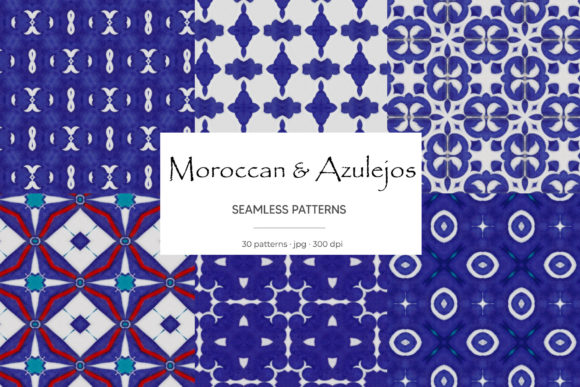
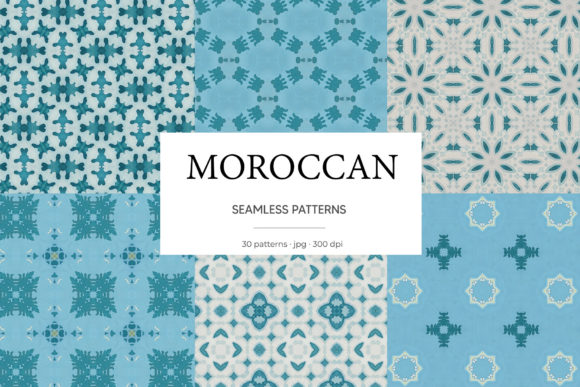
Moroccan seamless patterns are digital design assets composed of repeating motifs inspired by traditional Moroccan art—featuring geometric shapes, interlacing lines, arabesques, zellige tilework, and stylized floral elements. Unlike tiled or cropped pattern files, these are truly seamless: edges align perfectly when repeated horizontally and vertically, eliminating visible seams in large-scale applications. The set described here includes 30 distinct patterns, each delivered as a high-resolution JPG file at 3600×3600 pixels and 300 dpi—suitable for both print and digital use.
Why Consider Moroccan Seamless Patterns?
Designers, crafters, and small business owners often seek culturally resonant, visually rich backgrounds that convey elegance, heritage, or artisanal authenticity. Moroccan motifs offer a balance of structure and ornamentation, making them versatile across contexts—from modern branding to handcrafted stationery. A curated set like this provides immediate access to consistent, professionally scaled patterns without requiring custom illustration or time-intensive tiling adjustments.
Users commonly explore Moroccan seamless patterns when developing visual identities with North African or Mediterranean influences, designing wedding materials for destination or culturally themed events, or producing physical goods such as packaging, journals, or home décor items. The appeal lies not only in aesthetic distinction but also in functional reliability: each file is pre-tested for seamlessness and optimized for common production workflows.
Practical Benefits and Realistic Expectations
The primary benefit of this collection is efficiency. With 30 ready-to-use patterns, users avoid the labor of creating or sourcing individual designs. Each file maintains uniform resolution and color fidelity, supporting consistency across multi-element projects—for example, matching invitation suites, place cards, and wrapping paper using coordinated motifs. The 3600×3600 pixel dimension allows for scaling up to A3 or letter-size prints without loss of clarity, while remaining manageable for web-based layouts or digital mockups.
However, expectations should align with the format’s limitations. As JPGs, these files do not support transparency or layered editing. Users needing transparent backgrounds (e.g., for overlaying text or logos) will need to convert or mask files manually—or consider PNG alternatives if available elsewhere. Likewise, vector-based scalability isn’t possible with raster JPGs; extreme enlargement beyond standard print sizes may reveal pixelation.
Color representation is another consideration. While the patterns reflect typical Moroccan palettes—ochres, cobalt blues, emerald greens, ivory, and deep reds—the exact appearance depends on monitor calibration and printer profiles. For brand-critical applications, soft-proofing against CMYK output or requesting physical swatches from a print provider is advisable before final production.
Where This Set Fits Best
This collection is especially well-suited for users engaged in tangible, print-forward projects. It supports scrapbooking, handmade stationery, planner stickers, greeting cards, and decoupage with minimal technical overhead. Wedding professionals preparing invitation suites, seating charts, or ceremony signage will find the scale and resolution sufficient for professional printing services. Similarly, small-batch producers of journals, notebooks, or gift wrap can apply these patterns directly to cover templates or packaging mockups.
Businesses building cohesive visual systems—including logos, business cards, and branded merchandise—may use select patterns as secondary textures behind primary branding elements. Because Moroccan motifs tend toward symmetry and repetition, they integrate predictably into grid-based layouts common in editorial design or e-commerce product displays.
Educators or hobbyists exploring cultural design traditions may also benefit. The variety across the 30 patterns illustrates stylistic range—from bold, angular geometry reminiscent of Meknes architecture to softer, vine-like scrolls echoing Fez manuscript illumination. This diversity supports comparative study or thematic selection based on project tone.
Situations Where Alternatives May Be Preferable
For users requiring flexibility in color customization, vector-based pattern libraries (e.g., AI or SVG formats) offer non-destructive recoloring and infinite scalability. If your workflow relies heavily on Adobe Creative Cloud tools, a vector set would allow dynamic adjustments without raster degradation.
Designers working exclusively in digital environments—such as UI/UX interfaces, app backgrounds, or social media templates—might prioritize lightweight, web-optimized formats (e.g., SVG or compressed PNGs) over high-DPI JPGs intended for print. File size and loading performance become relevant considerations in those cases.
Additionally, if cultural specificity or historical accuracy is central to a project, consulting primary sources—such as museum archives or academic publications on Moroccan decorative arts—can supplement pattern use with contextual understanding. Relying solely on aesthetic borrowing risks flattening nuanced regional distinctions between, say, Saharan Berber motifs and Andalusian-influenced urban tilework.
Making an Informed Choice
Before acquiring any pattern set, assess how it aligns with your technical environment, output requirements, and creative goals. Ask: Will I print at scale? Do I need transparency or editable layers? Is color accuracy mission-critical? Does the motif support—not compete with—the content it frames?
This particular set of 30 Moroccan seamless patterns meets clear practical needs: high-resolution, print-ready, consistently formatted files ideal for crafters and small studios managing end-to-end production. Its strength lies in reliability and breadth—not novelty or customization. If your priority is speed, visual cohesion, and broad applicability across physical media, it represents a sound investment.
Conversely, if your work demands iterative design exploration, frequent color shifts, or integration into complex layered compositions, you may want to evaluate hybrid solutions—such as pairing a few key Moroccan patterns with editable vector resources or licensed illustration assets.
Final Considerations
When evaluating Moroccan seamless patterns, treat them as tools—not shortcuts. Their value emerges most clearly when matched thoughtfully to project scope, audience expectations, and production constraints. The 30-pattern set described offers breadth and readiness, but its usefulness depends on whether those qualities intersect with your actual workflow.
Review sample previews carefully—not just for motif preference but for edge alignment and contrast levels. Test one or two files in your intended software and output method before committing to full implementation. And remember: strong design decisions stem less from asset acquisition and more from intentional application. Moroccan seamless patterns can reinforce meaning and elevate execution—but only when selected with purpose.